
The Freudian Doublethink Effect
How Sigmund Freud’s turn preserved trauma as psychic meaning while withdrawing it as social evidence.

One of the most familiar tragic patterns in the history of science is the Semmelweis effect. A discovery appears, but the institution that would be indicted by that discovery cannot, or will not, absorb it.
Ignaz Semmelweis was not simply proposing a new medical technique when he insisted on the importance of hand disinfection.
His discovery was far more unbearable than that. It meant that doctors, who understood themselves as healers, might be transmitting death with their own hands.
Knowledge here would not merely have corrected professional practice. It would have made responsible those who regarded themselves as the bearers of professional authority.
The Semmelweis effect, then, does not simply mean that people dislike new evidence. It names a more precise and more merciless pattern.
A community resists evidence most fiercely when that evidence reveals not only error, but responsibility.
When new knowledge does not merely say, you were thinking incorrectly, but also, while trying to act rightly, you caused harm.
Denial in such cases is not mere stupidity. It is self-defense. The self-defense of an institution against its own guilt.
In Sigmund Freud’s history, we seem to encounter a reversed, more internal version of this pattern.
Here it is not simply a matter of an external institution rejecting a dangerous discovery. The drama is more disturbing than that: the discoverer himself begins to recoil from what his own theory would mean socially.
Freud’s early seduction theory was not merely a clinical hypothesis. If it was true, then hysteria and certain neuroses were not rooted primarily in female nervousness, constitutional sensitivity, or internal fantasy, but in childhood sexual trauma, adult abuse, family authority, and social silence.
This was the unbearable consequence of the discovery. If the speech of female patients testified to real violence, then the symptom could not remain inside the patient’s body. It stepped out of the consulting room. It named the family, the father, the relative, the educator, the physician, the teacher, the entire world of adult authority. In that case, hysteria was not the secret of the female psyche, but an indictment of the bourgeois family.
Not the mystery of the female body, but the archive of a social order.
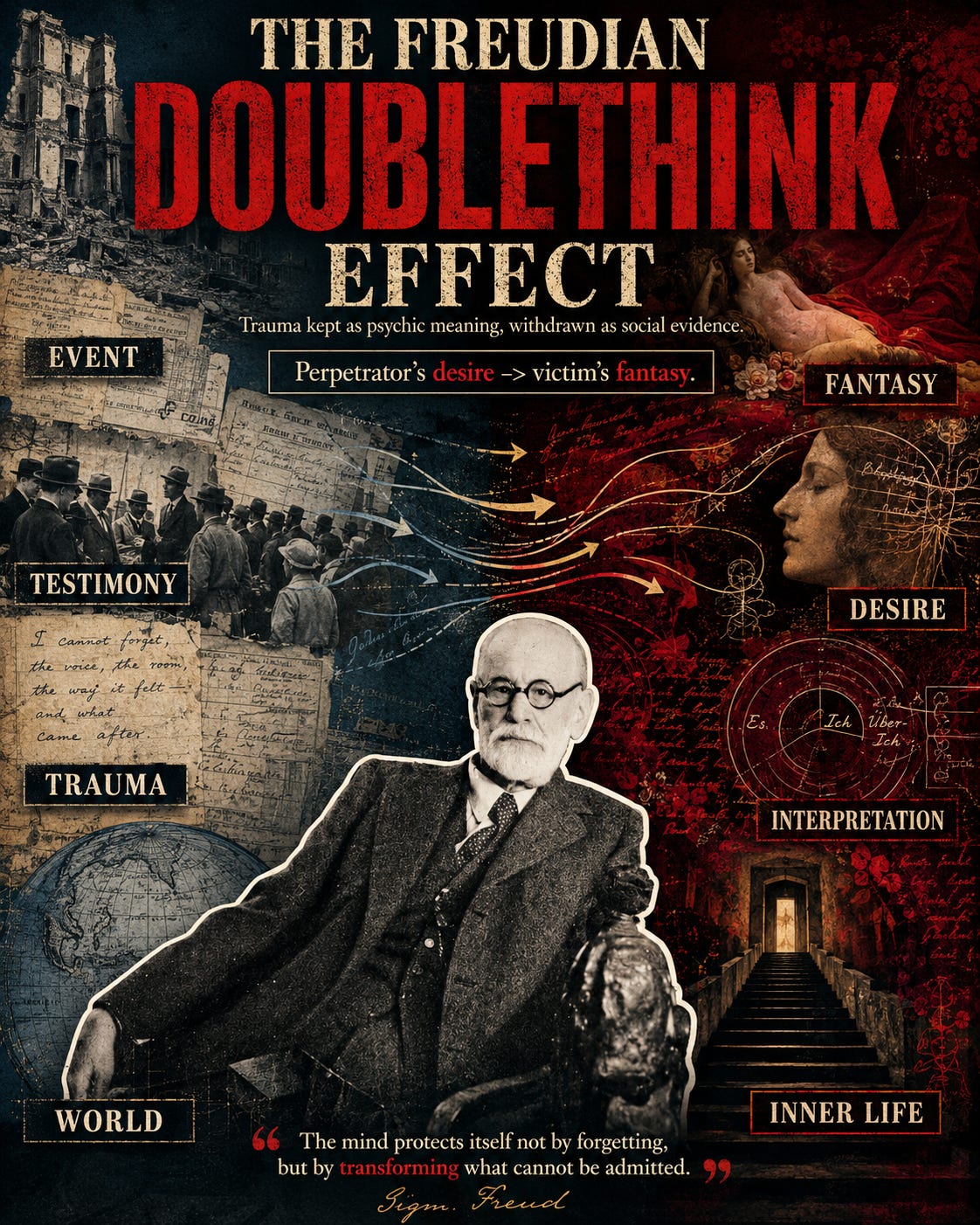
Here we encounter what we may call the Freudian doublethink effect. The discovery does not disappear completely. It does not simply collapse.
It does not become nothing. Rather, it enters a system of double accounting. Freud preserves women’s speech as clinical material, but withdraws it as social evidence.
He preserves trauma as psychic meaning, but weakens it as testimony about the world. The patient’s account remains important, only no longer at the level at which the speaker herself claims it to be true.
This is what distinguishes Freud’s turn from simple denial.
It is not that the speech of female patients is simply thrown out of the domain of medical knowledge.
On the contrary, psychoanalysis learns to think about the unconscious precisely from these forms of speech. Women’s speech becomes central material. It is listened to, recorded, analyzed, interpreted, and transformed into a system. But in the process, its status changes. What could previously have pointed to an event increasingly begins to point to fantasy, desire, repression, and internal conflict. Testimony does not disappear. It is transposed.
The most serious consequence of the Freudian turn, however, is not exhausted by saying that an external event was replaced by internal fantasy. That would still be too mild a formulation.
The deeper problem is that, in this displacement, the desire of the adult perpetrator could also be transferred onto the side of the victim. What might originally have been read as the violent act of adult power, sexual abuse, familial authority, or pedagogical authority could later appear, within psychoanalytic interpretation, as the material of the child’s or the woman’s own fantasy, desire, or unconscious conflict.
This is not a simple misunderstanding. It is a reversal in the direction of truth. The desire that operates on the side of the perpetrator returns as an explanation inside the victim’s psyche.
Adult sexual aggression becomes legible as the child’s fantasy. The relation of power is blurred, and what might earlier have pointed to an asymmetrical situation of violence increasingly becomes part of the patient’s internal drama.
This is why it is not enough to say that Freud transformed event into fantasy. The more precise claim is more serious: his turn made it possible for the perpetrator’s desire to be read back as the victim’s fantasy.
Social and sexual violence did not merely disappear from the clinical explanation, it returned as evidence of the victim’s inner life.
This is the darkest point of the Freudian doublethink effect.
Trauma is not annihilated, it is renamed. The adult’s desire does not remain with the perpetrator, but appears as fantasy in the psyche of the child or woman. The victim’s speech does not merely lose its evidentiary force. It turns against itself: what she says no longer testifies primarily to what was done to her, but to what she desired, imagined, repressed, or carried as unconscious conflict.
Here lies the true radicality of the betrayal… Not simply in the fact that women’s testimony was not believed, but in the fact that the material of testimony could generate an interpretation that translated the trace of adult violence back into the victim’s fantasy. The witness did not simply become a patient.
The witness became a patient whose speech no longer made the perpetrator suspicious, but herself.
One of psychoanalysis’s founding promises was that it would listen to what the medical, moral, and social discourses of the time could not, or would not, hear. It did not treat the symptom as a mere disorder, suffering as simple weakness, or female nervousness as constitutional obscurity, but as a meaningful formation. After Freud, convulsion, paralysis, pain, anxiety, dreams, slips, and repetition were no longer merely disturbing residues. They became traces. Material in which the subject’s history continued even when the subject herself could no longer tell it directly.
But this is precisely where the darkest question of Freud’s legacy opens.
Listening is not the same as validation.
Attention is not the same as accepting the speaker’s statement as a statement about the world. Psychoanalysis did not only ask what the patient was saying. It asked what what she said really meant.
This question was both liberating and dangerous. Liberating, because it sought repression, conflict, desire, and trauma beneath surface speech. Dangerous, because from that point on, the patient’s own sentence could never remain entirely identical with itself. It could always be something else as well: transference, fantasy, wish fulfillment, screen memory, repressed conflict, or symptomatic formation.
Freud’s early seduction theory stood precisely on this threshold. In the mid-1890s, Freud still believed that hysteria and certain neuroses were rooted in childhood sexual trauma.
The point was not that every detail of every account could be verified without difficulty. Even then, there were uncertainties, reconstructions, clinical inferences, retrospective memories, and interpretive gestures. But the center of gravity of the model was nevertheless different from what it would later become. Behind the symptom stood the possibility of an external event, adult abuse, childhood vulnerability, and familial or authoritative violence.
The patient’s speech therefore did not merely reveal the internal operations of the psyche. It also spoke of the world in which the injury could have taken place.
This possibility was profoundly uncomfortable. If hysteria was rooted in childhood sexual violence, then illness did not remain inside the patient. It could not be treated entirely as a problem of the female nervous system, female constitution, hypersensitivity, sexuality, or fantasy. The symptom then marked out a social space as well: family, room, kinship relation, pedagogical situation, dependency, silence, shame, authority.
In this reading, neurosis was not a private matter.
Not exclusively an internal conflict. Not merely the hidden mechanism of the soul. It could also be evidence that inside the civilized, bourgeois, supposedly moral order of the family there operated a violence that this very order was unable to recognize.
This is why seduction theory was more dangerous than it might first appear. It was not merely an early theory of trauma. It did not merely claim that childhood matters. Later Freud retained that point, though with different emphases.
Seduction theory carried a more radical consequence: it treated the speech of female patients as possible testimony, speaking not only of the subject’s past, but also of the violent structure of the social order.
A sentence spoken in the consulting room could have stepped outside the consulting room. It was not only psychological data. It could also have been an indictment.
In 1896, in his lecture The Aetiology of Hysteria, Freud still occupied a theoretical position in which the origin of the symptom could not be separated from the possibility of an actual event. He did not seek the explanation of hysteria simply in constitutional predisposition, female nervousness, or inherited weakness, but in early experiences that had been impossible for the patient to process.
In this model, childhood sexual trauma was not a metaphor, but an etiological factor. Not merely a later fantasy, but an injury whose trace continued to live on in the body, in speech, and in the symptom.
It is important, however, not to idealize this early Freud retroactively. Even then, Freud was not simply collecting reports, nor was he treating testimonies that could be transferred unchanged into the language of law or history. He worked with clinical inferences, reconstructions, fragments of memory, stories read backward from symptoms, and interpretive techniques that already gave considerable power to the physician.
Seduction theory, then, was not naive realism. It did not mean that Freud simply accepted every spoken account as a verified fact. Rather, it meant that the center of gravity of the explanation still leaned toward the external event, adult intervention, and childhood vulnerability.
This is why the moment of 1896 is both radical and fragile. Radical, because it tied hysteria to past experiences in which the patient was not merely the author of her own internal conflict, but the sufferer of an asymmetrical situation. Fragile, because Freud’s evidence, clinical methods, and conclusions did not meet what we would now call historical, forensic, or empirical standards of proof. The strength and weakness of seduction theory came from the same source: it bound the symptom very tightly to a silenced event, while the path leading to that event itself passed through interpretations, fragments, and reconstructions.
A year later, Freud was already speaking about the question differently.
In his 1897 letter to Wilhelm Fliess, the famous turn appears: Freud no longer believes in his neurotica, that is, in the theory that more generally assumed real childhood sexual seduction or abuse behind the neuroses. This sentence is often read as if everything had been decided in a single moment:
Freud believed, then he no longer believed.
But the history is slower, more confused, and theoretically much more important than that. This was not a simple act of repudiation, but a shift in the center of gravity, whose consequences became fully visible only later.
Freud had clinical and logical doubts of his own.
If every hysterical and neurotic symptom were rooted in actual childhood sexual abuse, then the frequency of such acts would have had to be almost inconceivably high. To him, this may have seemed not only an empirical difficulty, but also a social impossibility.
Here the discovery reaches the limit of what can be endured. It is not simply that Freud failed to find sufficient evidence. It is also that
the consequences of the theory drew the outline of a world in which the bourgeois family, paternal authority, and respectable adult roles would become suspect on a massive scale.
At this point, the word improbable is not innocent.
Societies often call improbable what they cannot bear to know about themselves. If a theory claims that violence is not an exception, but a structurally recurring possibility, if it suggests that the family may be not only a place of protection, but also a place of danger, if it demands that the speech of the child or the woman be taken seriously even against authority, then the theory does not merely encounter professional resistance. It encounters the self-defense of a worldview.
Freud’s turn, therefore, cannot be reduced to the abandonment of an early theory.
Trauma did not disappear completely from psychoanalysis, but it lost the primary explanatory place it had occupied in seduction theory.
Fantasy, unconscious desire, repression, transference, and later the Oedipus complex assumed an increasingly organizing role. With this, psychoanalysis opened up a vast new conceptual space. It cannot simply be said that this space was intellectually sterile. On the contrary, it is also from here that much of the extraordinary force of Freud’s thought derives. But that force came at the price of weakening the social legibility of external violence.
One of the sharpest later formulations of this debate was given by Jeffrey Moussaieff Masson in The Assault on Truth. Masson did not read Freud’s turn as a mere theoretical change, but as the suppression of truth. According to him,
Freud withdrew from seduction theory because its consequences were too threatening to the acceptability of psychoanalysis, to bourgeois society, and to male authority.
Masson’s reading is strong, sometimes too strong, accusatory, sometimes reductive. But the scandal he named does not disappear simply because his formulation can be disputed. The question remains: what was lost when the speech of women and children became primarily psychic material rather than social evidence?
Masson’s significance does not lie in having closed the case on Freud once and for all. Rather, it lies in having made visible again the moral and political stakes of the turn.
The history of psychoanalysis is not merely a history of concepts. It is also a history of institutions, archives, authorities, and professional loyalties. How we read one of Freud’s letters is not only a philological question. It is also a question of who is entitled to interpret Freud’s legacy, and what price we pay if we cleanse the founding gesture of psychoanalysis too quickly of its violent consequences.
This is why Florence Rush’s feminist reading of trauma is such an important counterpoint.
Rush did not treat the question as Freud’s personal psychodrama, but as part of a broader social system of silencing. Sexual violence against children does not remain invisible because there are no signs of it, but because too many institutions, families, and forms of authority have an interest in preventing it from becoming common knowledge. From Rush’s perspective, Freud is not a solitary traitor, but a key figure in a culture that was able to hear the symptom, yet unable to bear the possibility that the symptom pointed toward violence inside the family.
This feminist reading expands the Freud debate.
The question is not what moral error one male scientist committed. It is how an entire order of knowledge operates when the speech of victims could name perpetrators who occupy socially respectable positions.
The father, the relative, the educator, the physician, the teacher, the pastor, or the family friend are not accidental figures in this story. They are the figures to whom trust is socially assigned.
If their desire, violence, or abuse were placed at the center of the explanation, then society would have to interpret not the mystery of the hysterical woman, but the corruption of its own structures of trust.
From this perspective, the Freudian doublethink effect is not merely Freud’s personal dilemma, but a more general danger of modern institutional knowledge.
Speech can be admitted in such a way that it is neutralized. It can be examined, classified, interpreted, and archived in such a way that it loses its accusatory force.
The victim’s speech does not fall into silence, it enters expert language. And this expert language can both give it a place and take away its capacity to testify against the world.
Within psychoanalysis itself, however, not everyone accepted this direction.
Sándor Ferenczi is an especially important figure because he did not attack Freud’s legacy from the outside, but tried from within to reopen the reality of trauma that had become uncertain after the Freudian turn. His 1932 text, Confusion of Tongues Between Adults and the Child, names precisely the point that matters here: the passion of the adult and the tenderness of the child do not operate in the same language.
The child is not the secret author of the adult’s desire. Not the hidden partner in the adult’s sexual scene. Not its imaginary initiator. The child is its vulnerable addressee.
Ferenczi’s significance therefore goes beyond a personal critique of Freud. He represents the possibility that psychoanalysis, using its own tools, can return to the reality of trauma. Not by abandoning the unconscious, fantasy, or internal conflict, but by refusing to allow these concepts to obscure the asymmetry of power.
In Ferenczi, the relation between child and adult is not the encounter of two equivalent desires, but the collision of two entirely different positions.
On one side there may be power, an adult body, social authority, and sexual aggression, on the other, dependency, trust, the need for tenderness, and the compulsion to survive.
It is not enough to speak of fantasy if we do not ask whose fantasy is at stake. It is not enough to interpret desire if we do not ask on which side power stands. It is not enough to read the symptom if, in doing so, we obscure the social space in which the symptom was formed. Psychoanalysis can avoid its own betrayal only if it is able to distinguish between the child’s vulnerability and the adult’s desire.
In this sense, Ferenczi can be read as the internal conscience of psychoanalysis. Not because he was right against Freud on every question, but because he reached back toward a place that psychoanalysis had made uncertain too quickly:
the event-character of trauma, the vulnerability of the child, and the fact that violence cannot be translated entirely into the language of meaning without something decisive being lost. Trauma does not only mean something. It also happened to someone.
The debate around Freud therefore becomes truly important only when we do not confine it to Freud himself. Freud’s turn opens a larger question:
how does knowledge handle forms of speech that carry too much social responsibility? How does testimony become data, data become interpretation, interpretation become theory, and theory become a system that no longer necessarily allows the speaker to return to her original claim that something happened to her?
At this point, Freud’s name is no longer merely a historical name. It is not only the name of a Viennese physician, not only the founder of psychoanalysis, and not simply the author of a contested theoretical turn. Here, Freud’s name becomes the name of a knowledge operation in which the speech of the suffering person enters expert language, and thereby receives a place, a meaning, and a risk all at once. What perhaps had not been heard before is now listened to. What had previously been called mere disturbance, exaggeration, weakness, or female nervousness is now treated as meaningful material. But with this comes a new danger: that speech becomes intelligible only when it is no longer understood entirely at the level on which it was spoken.
This is not exclusively the problem of psychoanalysis. Every form of expert knowledge carries this ambivalence.
Without expert language, much suffering would remain nameless. We would have no concepts for trauma, dissociation, repression, dependency, abusive dynamics, repetition compulsion, or for the ways in which the past can return in bodily, linguistic, and behavioral forms. Concepts can liberate. They can free suffering from the old moralizing language that saw in it only weakness, sin, hysteria, or a defect of character.
Naming can itself be a form of justice. It can be the first condition of making something communicable at all.But the same expert language that gives suffering a name can also rearrange its direction.
The danger does not begin when speech is interpreted. Without interpretation, there is no therapy, no historical understanding, no theory of trauma, no responsible inquiry.
The danger begins when interpretation closes down the referential claim of speech. When the suffering person’s sentence can only be about them, and less and less about the world in which they were wounded. When the question is no longer what event, what relation, what power, what institution, or what person produced the injury, but how the injured person’s inner world reproduces, distorts, reshapes, or symbolizes it.
The question, then, is not whether expert language is necessary. It is. Nor is it whether interpretation is necessary. It is. The question is whether interpretation preserves the relation between speech and the world to which that speech refers.
Testimony cannot become an untouchable dogma, but neither can it be treated as mere psychic raw material. If we treat it only as dogma, we give up investigation. If we treat it only as raw material, we give up the possibility that the speaker is making a claim about the world. The difficulty lies precisely in this double obligation: to listen critically while not taking away the referential claim of speech.
This is especially important when it comes to the concept of fantasy. Fantasy is not the enemy. Memory is not a mechanical recording. The past does not simply remain inside us like a sealed archive. Human memory is fragmented, retrospectively organized, saturated with affect, connected to other stories, and repeatedly reinterpreted.
The concept of the unconscious was fertile precisely because it showed that the subject is not fully master of what she says, thinks, desires, or repeats. Psychic reality is not identical with a simple copy of external events.
But it does not follow from this that the external event can lose its priority when violence, abuse, or asymmetry of power is at stake.
The concept of fantasy becomes dangerous when it no longer supplements the understanding of trauma, but occupies its place. When it no longer asks how injury lived on in the psyche, but suggests that the truth of the injury lies primarily in the psyche. When the richness of inner life obscures the brutality of external action. When the complexity of the unconscious blurs the simple fact of power.
This is why it is not enough to say that every speech act requires interpretation. That is true, but by itself too convenient. The decisive question is what interpretation does to the object of speech. Does it add something to what the speaker says, or does it take away what she is speaking about? Does it deepen testimony, or appropriate it? Does it show how trauma works in the psyche, or does it return to the psyche what happened in the world? Interpretation becomes betrayal when the question “what does it mean” erases the question “what happened”?
The peculiar status of testimony arises from exactly this. It is not identical with proof, but neither is it mere material prior to proof. It cannot automatically be treated as final truth, but neither can it be deprived in advance of its claim to truth. Testimony always requires a double movement: listening and investigation.
But the order and tone are not indifferent.
If investigation approaches speech from the first moment as though it were really about something else, then the speaker does not enter the space of knowledge as a witness, but as a suspicious object. The question will not be what happened to her, but why she says that something happened to her.
This difference is not merely legal or clinical. It is also deeply political and moral. The speech of the witness is always disturbing because it brings not only information, but responsibility. It does not merely communicate data, it unsettles relationships: family ties, professional authorities, institutional self-images, social structures of trust.
This is why testimony is often unbearable not because it is impossible to understand, but because it is all too understandable. If it is true, someone must answer. If it is true, something can no longer be called innocent.
Interpretation, by contrast, is sometimes attractive precisely because it makes speech more bearable.
Meaning can be richer than the mere event. But it can also be more convenient.
Where there is an event, there is also an actor. Where there is an actor, there is responsibility. But where everything is primarily meaning, responsibility more easily disperses, deepens, becomes abstract, and finally loses the crude direction it once had toward a concrete world.
Trauma does not disappear, it becomes refined. It is not denied, but placed into a language in which it is less able to accuse.
Freud’s legacy, therefore, is not that we should beware of all interpretation. That would be impossible, and it would betray the best insights of psychoanalysis itself. Rather, the legacy is that we must know this: listening itself is a form of power.
Whoever listens does not merely receive speech. They select what counts as important. They decide into which concepts it will be placed. They determine what in it is event, what is memory, what is fantasy, what is desire, what is distortion, what is symptom, and what is evidence. Listening is not a neutral space. Listening is always also an ordering.
The question is not whether Freud must be condemned or saved. That is too small a question for what this story reveals.
The question is whether a form of knowledge can attend to the speech of the suffering person without appropriating its object.
Whether it can go beneath the surface without destroying the surface’s simplest claim. Whether it can speak of the unconscious without forgetting the perpetrator. Whether it can interpret fantasy without relocating responsibility to the place where there was originally vulnerability.
Because the speech of the suffering person does not ask only for meaning.
Sometimes it asks for truth. Not only for someone to understand the inner trace left by the injury, but also for someone not to turn away from the world in which the injury took place.
Perhaps, then, the greatest lesson of psychoanalysis is not that there is always something deeper behind speech. It is that sometimes the deepest thing is precisely what the speaker is trying to say first: that something happened. That someone did it. That the wound is not merely an internal formation, but the trace of the world in the body and in speech.
After Freud, we know that the symptom means. But we must also know that meaning cannot absolve the world.
Listening does not become another betrayal only if interpretation does not take from the witness the right to speak not only about herself, but about the world.
References
Borch-Jacobsen, Mikkel. Freud’s Patients: A Book of Lives. London: Reaktion Books, 2021.
Borch-Jacobsen, Mikkel, and Sonu Shamdasani. The Freud Files: An Inquiry into the History of Psychoanalysis. Cambridge: Cambridge University Press, 2012.
Breuer, Josef, and Sigmund Freud. Studies on Hysteria. Translated and edited by James Strachey. London: Hogarth Press and the Institute of Psycho-Analysis, 1955.
Esterson, Allen. Seductive Mirage: An Exploration of the Work of Sigmund Freud. Chicago: Open Court, 1993.
Ferenczi, Sándor. “Confusion of Tongues Between Adults and the Child: The Language of Tenderness and of Passion.” International Journal of Psycho-Analysis 30 (1949): 225–230.
Freud, Sigmund. “The Aetiology of Hysteria.” In The Standard Edition of the Complete Psychological Works of Sigmund Freud, Vol. 3, edited and translated by James Strachey, 187–221. London: Hogarth Press, 1962.
Freud, Sigmund. The Complete Letters of Sigmund Freud to Wilhelm Fliess, 1887–1904. Edited and translated by Jeffrey Moussaieff Masson. Cambridge, MA: Belknap Press of Harvard University Press, 1985.
Herman, Judith Lewis. Trauma and Recovery: The Aftermath of Violence—from Domestic Abuse to Political Terror. New York: Basic Books, 1992.
Malcolm, Janet. In the Freud Archives. New York: Alfred A. Knopf, 1984.
Masson, Jeffrey Moussaieff. The Assault on Truth: Freud’s Suppression of the Seduction Theory. New York: Farrar, Straus and Giroux, 1984.
Miller, Alice. The Drama of the Gifted Child: The Search for the True Self. Translated by Ruth Ward. New York: Basic Books, 1981.
Rush, Florence. The Best Kept Secret: Sexual Abuse of Children. Englewood Cliffs, NJ: Prentice-Hall, 1980.
Sulloway, Frank J. Freud, Biologist of the Mind: Beyond the Psychoanalytic Legend. New York: Basic Books, 1979.